


How can the ventilation design of a custom shoe cabinet effectively prevent the accumulation of internal odors?
Release Time : 2025-12-17
Ventilation design is crucial for preventing odor buildup in custom shoe cabinets. Its effectiveness depends on ventilation path planning, material selection, and synergy with the overall structure. Odors primarily originate from residual sweat, bacterial decomposition products, and the natural evaporation of leather or rubber from shoes. If ventilation is inadequate, these substances will accumulate in the enclosed space, creating a pungent smell. Therefore, the ventilation design of a custom shoe cabinet must be based on the principles of airflow, constructing a multi-dimensional and sustainable odor removal mechanism.
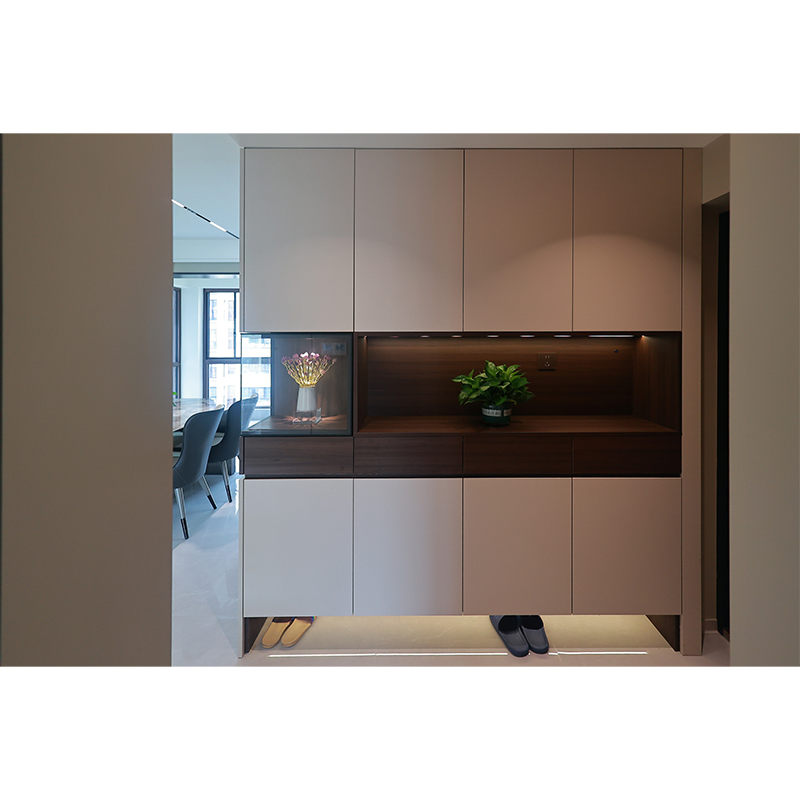
Planning the ventilation path is paramount. The ventilation design of a custom shoe cabinet must avoid "dead zones," areas where air cannot circulate. For example, pre-installing ventilation openings at the back or bottom of the cabinet creates a "through-draft" effect, allowing fresh air to enter from the bottom and carry odors out from the back. If the cabinet has a built-in design, ventilation channels should be added to the top or sides, utilizing the principle of rising hot air to accelerate odor diffusion. Furthermore, maintaining a 1-2 cm gap between the shelves and the back panel prevents direct contact between the shoe soles and the panels, reducing odor absorption and providing a channel for airflow.
The choice of materials directly affects ventilation efficiency and odor absorption capacity. The materials for the back panel, shelves, and doors of a custom shoe cabinet must balance breathability and moisture resistance. For example, using environmentally friendly boards with a microporous structure ensures structural strength while promoting air exchange through the pores. If the budget allows, metal mesh or rattan can be used in some areas, as their natural breathability significantly improves ventilation. It's important to note that the material surface must be treated with moisture-proof materials to prevent deformation or mold growth due to excessive humidity, which could exacerbate odor problems.
The cabinet door design is a crucial element of the ventilation system. Traditional fully enclosed doors tend to create a sealed space, hindering airflow, while open designs, although providing good ventilation, are prone to dust accumulation. Therefore, custom shoe cabinets often employ a compromise of "semi-open + vent": long, narrow vents are placed below or above the cabinet door, maintaining an overall aesthetic while allowing air convection. For even higher ventilation efficiency, louvered or grid doors can be used; their angled blades guide airflow in a specific direction while preventing direct airflow that could shift shoes.
The design of the internal storage structure needs to be coordinated with the ventilation system. For example, adjustable shelves can be used, allowing for flexible spacing based on shoe height, preventing overly dense shelves from obstructing airflow. Shoe racks or footrests should feature openwork or angled designs to maximize the contact area between the shoe soles and the air, accelerating odor dissipation. Additionally, independent ventilation modules, such as small exhaust fans or activated carbon filters, can be installed inside the shoe cabinet to further purify the air through active ventilation or adsorption.
Environmental factors significantly impact ventilation effectiveness. If the custom shoe cabinet is located in a humid area (such as an entryway near a bathroom), moisture-proof nets should be installed at the ventilation openings to prevent backflow of moisture. In dry areas, the number of ventilation openings can be increased to enhance air exchange. Furthermore, the shoe cabinet should be 5-10 cm away from the wall to avoid obstructed ventilation and to allow for future maintenance.
Daily usage habits also affect the effectiveness of the ventilation system. For example, regularly clean the dust inside the shoe cabinet to avoid clogging the vents; dry wet shoes before placing them in the cabinet to reduce odors caused by moisture evaporation; and place natural deodorizers (such as bamboo charcoal bags or lemon slices) inside the cabinet to help purify the air. These habits complement the ventilation design, working together to build a long-term odor control system.
The ventilation design of a custom shoe cabinet requires a comprehensive approach considering six aspects: path planning, material selection, cabinet door structure, internal storage, environmental adaptation, and usage habits. Through scientific design logic and detailed optimization, even with long-term use, the inside of the shoe cabinet can maintain fresh air, adding comfort and health to daily life.