


How to perfectly fit an irregular or shapeless living room space with a custom-made TV cabinet?
Release Time : 2025-12-30
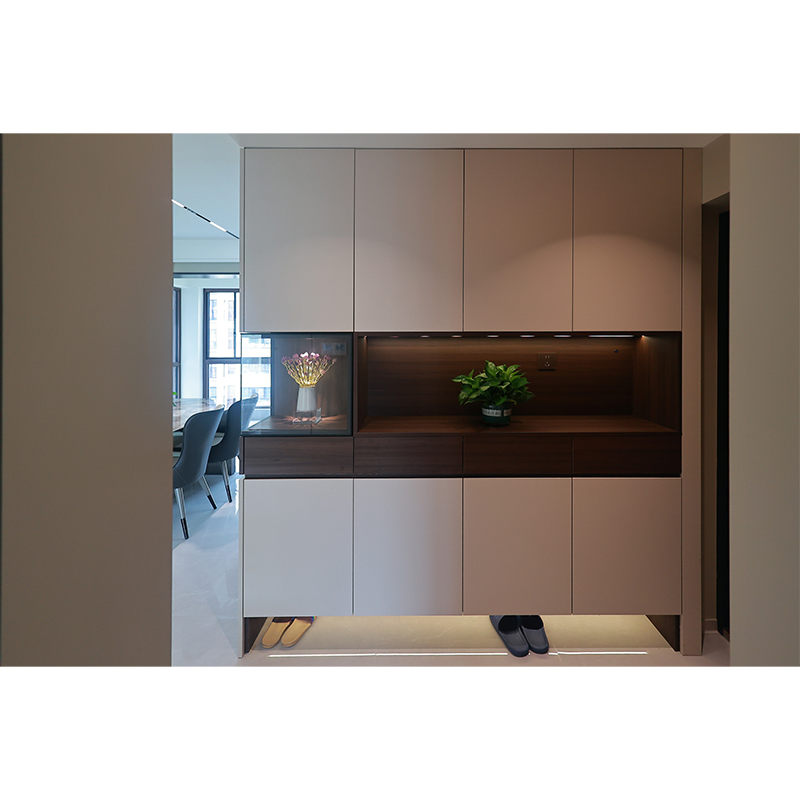
In modern homes, the living room is no longer just a place to entertain guests, but also the central stage of family life. However, not every family has a textbook square space—sloping beams, columns, protruding window sills, slanted walls, exposed pipes, and even curved corners—these "irregular" elements, while giving the space a unique personality, also present a significant challenge for furniture arrangement. Ready-made TV cabinets, due to their fixed dimensions and monotonous shapes, often struggle to fit snugly against irregular walls, leaving awkward gaps or blocking light, thus ruining the overall aesthetic. Custom-made TV cabinets, on the other hand, are designed to solve this problem. They are tailored to the specific needs of the space, transforming its "imperfections" into design highlights, achieving a seamless integration of function and aesthetics.
The core of customization lies in "adapting to the shape." The designer first conducts precise measurements of the living room, recording not only the length, width, and height, but also meticulously marking every beam, column, socket location, radiator direction, and even the window frame outline. Based on this real-world data, the TV cabinet is no longer an isolated piece of furniture, but a natural extension of the spatial structure. For example, when facing a sloping attic, the cabinet can be designed in a stepped or beveled shape; when encountering a load-bearing column, it can be cleverly incorporated into the cabinet to create symmetrical display shelves or hidden storage areas; if there are recesses in the wall, the cabinet can be embedded to create a seamless overall look. This ingenuity of "fitting every nook and cranny" ensures that every inch of space is respected and utilized.
Flexible selection of materials and craftsmanship further enhances adaptability. Custom-made TV cabinets can use boards of different thicknesses, hardnesses, and textures according to the site environment, ensuring that they meet actual needs in terms of load-bearing capacity, moisture resistance, and deformation resistance. Edge banding can be precise to the millimeter, fitting perfectly with the wall; corners are rounded or spliced at 45 degrees, ensuring both safety and aesthetics. For curved walls, hot-bent boards or segmented splicing techniques can be used to achieve a smooth curved surface effect, breaking the rigid impression of traditional right-angled furniture.
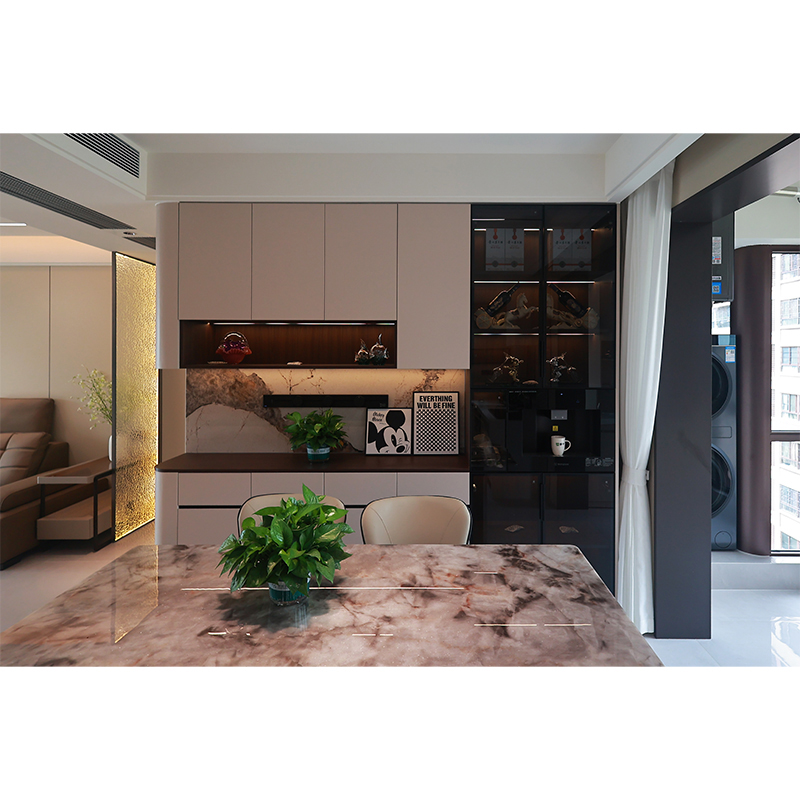
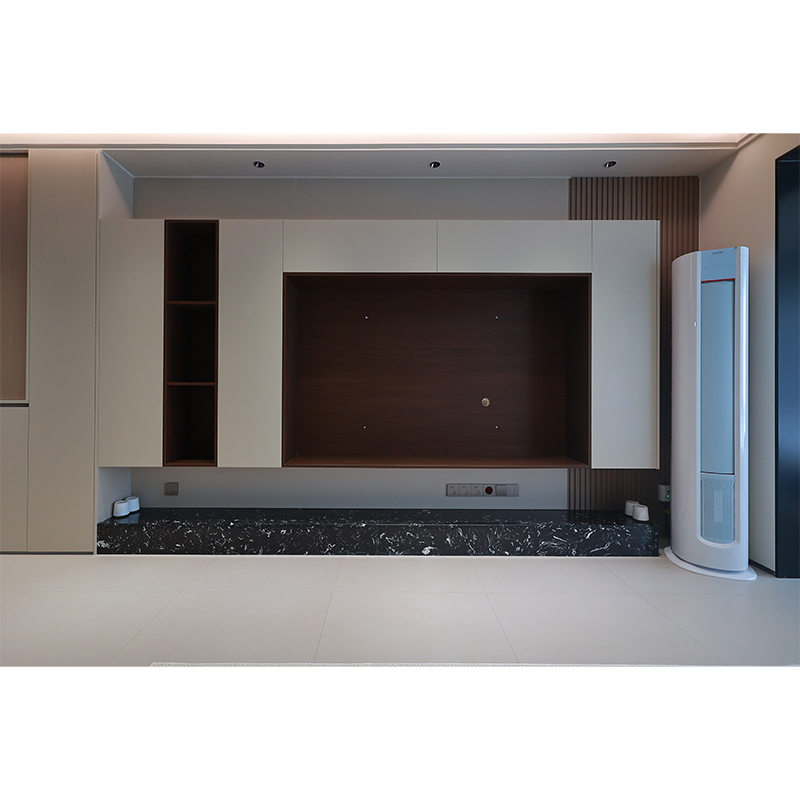
Functional layout also varies depending on the space. In long, narrow living rooms, TV cabinets can extend horizontally, combining open shelves with closed doors to balance visual weight. In spaces with limited ceiling height, they can extend upwards, featuring floor-to-ceiling storage systems to improve storage efficiency without feeling oppressive. If there's a bay window next to the TV wall, the cabinet can be built around the window, forming an L-shaped or U-shaped layout, organically integrating the leisure area and the audiovisual area. Electrical wires, network cables, and speaker wires can all be pre-embedded in the cabinet back panel or dedicated cable trays, achieving "invisible neatness."
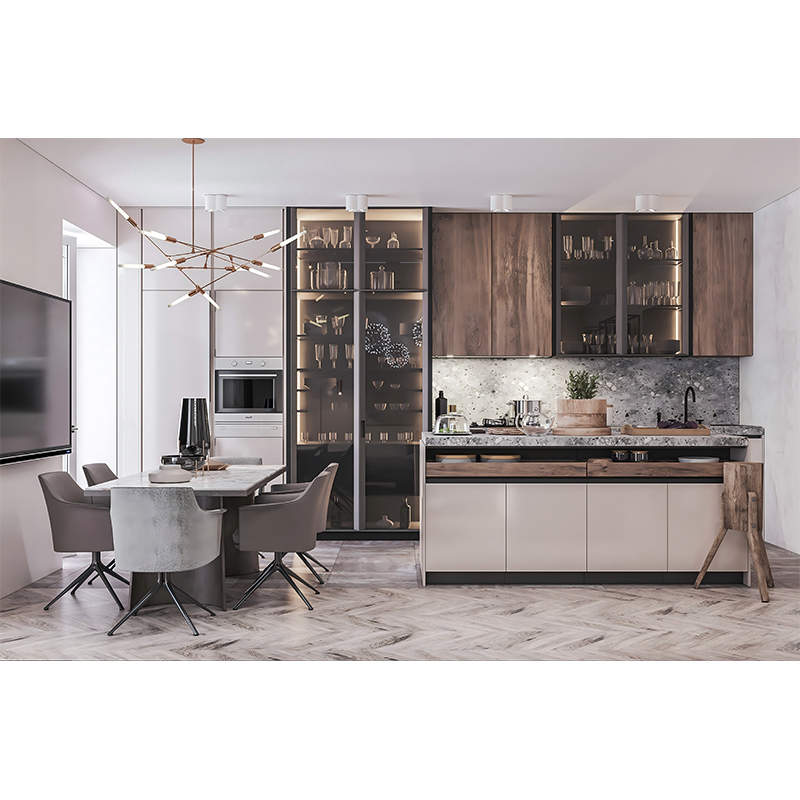
More importantly, customized TV cabinets can deeply integrate with the overall home décor style. Whether it's the micro-cement texture of wabi-sabi, the metal inlays of a minimalist style, or the mortise and tenon details of modern Chinese style, everything can be accurately reproduced during the customization process. Colors, textures, lighting, and even intelligent sensing systems can all be configured as needed, making the TV cabinet no longer an obtrusive "furniture," but rather a part of the wall, a part of art, and a part of life.
Ultimately, the value of customization lies not only in "fit," but also in "foresight." Designers consider future changes in family structure, equipment upgrades, or increased storage needs, reserving expansion interfaces or adjustable structures to ensure the TV cabinet's longevity. It doesn't chase fleeting trends but rather accompanies the family's growth with a steadfast presence.
In irregular spaces, true beauty isn't about forced correction, but about adapting to the space. A custom-made TV cabinet is precisely such a craftsman who understands the language of space—using precise dimensions, flexible forms, and thoughtful functionality to transform what was originally a "problem" into a unique poem of life. When the cabinet blends seamlessly with the wall, when clutter is quietly concealed, and when harmony is everywhere, we know: home has finally found its most comfortable form.
The core of customization lies in "adapting to the shape." The designer first conducts precise measurements of the living room, recording not only the length, width, and height, but also meticulously marking every beam, column, socket location, radiator direction, and even the window frame outline. Based on this real-world data, the TV cabinet is no longer an isolated piece of furniture, but a natural extension of the spatial structure. For example, when facing a sloping attic, the cabinet can be designed in a stepped or beveled shape; when encountering a load-bearing column, it can be cleverly incorporated into the cabinet to create symmetrical display shelves or hidden storage areas; if there are recesses in the wall, the cabinet can be embedded to create a seamless overall look. This ingenuity of "fitting every nook and cranny" ensures that every inch of space is respected and utilized.
Flexible selection of materials and craftsmanship further enhances adaptability. Custom-made TV cabinets can use boards of different thicknesses, hardnesses, and textures according to the site environment, ensuring that they meet actual needs in terms of load-bearing capacity, moisture resistance, and deformation resistance. Edge banding can be precise to the millimeter, fitting perfectly with the wall; corners are rounded or spliced at 45 degrees, ensuring both safety and aesthetics. For curved walls, hot-bent boards or segmented splicing techniques can be used to achieve a smooth curved surface effect, breaking the rigid impression of traditional right-angled furniture.
Functional layout also varies depending on the space. In long, narrow living rooms, TV cabinets can extend horizontally, combining open shelves with closed doors to balance visual weight. In spaces with limited ceiling height, they can extend upwards, featuring floor-to-ceiling storage systems to improve storage efficiency without feeling oppressive. If there's a bay window next to the TV wall, the cabinet can be built around the window, forming an L-shaped or U-shaped layout, organically integrating the leisure area and the audiovisual area. Electrical wires, network cables, and speaker wires can all be pre-embedded in the cabinet back panel or dedicated cable trays, achieving "invisible neatness."
More importantly, customized TV cabinets can deeply integrate with the overall home décor style. Whether it's the micro-cement texture of wabi-sabi, the metal inlays of a minimalist style, or the mortise and tenon details of modern Chinese style, everything can be accurately reproduced during the customization process. Colors, textures, lighting, and even intelligent sensing systems can all be configured as needed, making the TV cabinet no longer an obtrusive "furniture," but rather a part of the wall, a part of art, and a part of life.
Ultimately, the value of customization lies not only in "fit," but also in "foresight." Designers consider future changes in family structure, equipment upgrades, or increased storage needs, reserving expansion interfaces or adjustable structures to ensure the TV cabinet's longevity. It doesn't chase fleeting trends but rather accompanies the family's growth with a steadfast presence.
In irregular spaces, true beauty isn't about forced correction, but about adapting to the space. A custom-made TV cabinet is precisely such a craftsman who understands the language of space—using precise dimensions, flexible forms, and thoughtful functionality to transform what was originally a "problem" into a unique poem of life. When the cabinet blends seamlessly with the wall, when clutter is quietly concealed, and when harmony is everywhere, we know: home has finally found its most comfortable form.